
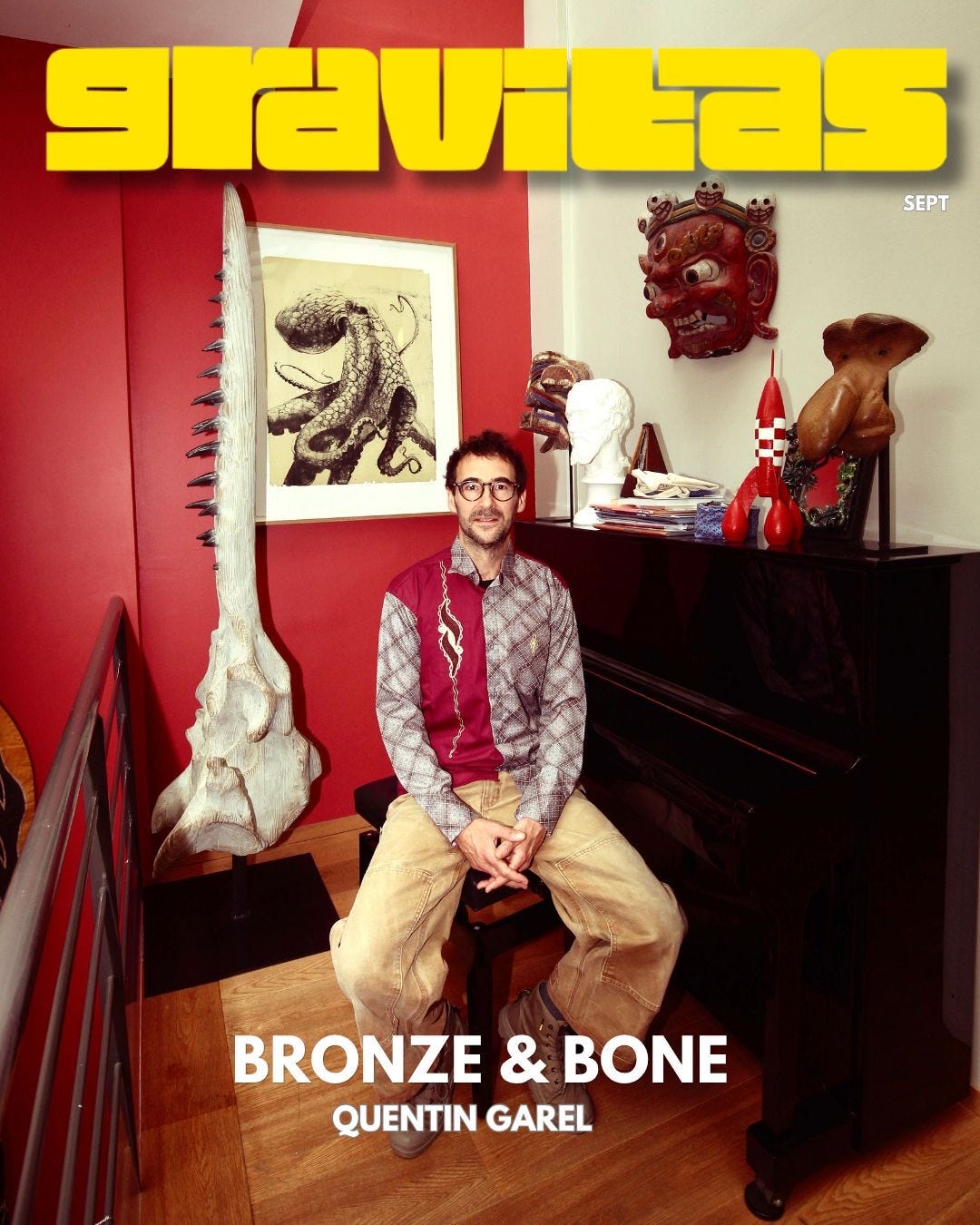
Before we ever set foot in Quentin Garel’s studio, our first impression of him was formed through someone else.
A few days before the shoot, we stopped by Galerie LJ in the 13th arrondissement to coordinate our filming schedule and capture preliminary footage of Quentin’s work. There, we met Adeline Jeudy.
To encounter Adeline is to meet someone entirely possessed by her subject. Full of life, articulate, and fiercely perceptive, she spoke about Quentin’s practice with an intimacy and technical depth that caught me completely off guard. Listening to her move through the mechanics of his bronzes, the grain of his timber, and the evolution of his ideas, three things became immediately clear. First, that she was exceptionally gifted at what she built. Second, that this was not a sterile business arrangement, but a deep and genuine friendship. And third, that Quentin Garel was an extraordinary artist.
It is one thing for a gallery owner to pitch a roster; it is another thing entirely for an art connoisseur of serious taste to evangelize an artist with that degree of mastery. Adeline was not reciting press releases. She was defending a worldview. Watching her mind work, seeing someone so steeped in another person’s creative architecture that she far exceeded any conventional duty, I felt a quiet, lingering envy. I left the gallery wishing that someday, someone would know as much about my own work and way of thinking as Adeline did about Quentin’s. To produce work of such coherence that a mind like hers is compelled to inhabit it completely is, to me, a benchmark of greatness.
When we finally arrived at Quentin’s home, that initial coherence was tested against an overwhelming physical reality.
Upstairs, the house functions as a private, luminous sanctuary. Under an expansive industrial glass roof, the daylight floods down into an open-plan living room and kitchen that feels less like a city apartment and more like a naturalist’s personal salon. A massive olive-green velvet sofa anchors the center of the room, flanked by towering bookshelves and walls layered with anatomical relics, mounted forms, and objects gathered across decades. It is domestic and lived-in, but charged with curiosity: a space designed for contemplation, reading, and shared meals.
The labor, however, lives entirely below.
Descending downstairs, the domestic warmth falls away, replaced by the cool, utilitarian atmosphere of two adjacent workshops. Here, side by side, is where the hard work of the practice actually takes place.
The first room is dedicated to drawing. The space is stark, with bare concrete floors and unadorned walls that strip away any romantic illusion of the artist’s studio. When we walked in, the back wall was dominated by an immense horizontal paper study: five charcoal renderings of a wolf’s head, tracking the creature’s gaze from profile to a piercing, front-facing stare. It was the preparatory blueprint for his upcoming installation with Jacques Marie Mage in New York. Along the shelves, thousands of CDs line the room, providing the sonic wallpaper for hours of quiet drafting.
Then, just through the doorway, sits the second room: the sculpting workshop. The air here smells of raw timber, motor oil, and foam dust. Clamps, chisels, angle grinders, and chainsaws crowd the heavy worktables alongside half-carved prototypes and animal skulls.
This architectural layout mirrors the fundamental tension of Quentin’s life. Side by side, separated only by a threshold, sit two radically different worlds: the silent, exacting discipline of charcoal, and the loud, violent theater of heavy machinery.
The first paradox of Quentin’s work is visual. When you stand in front of one of his monumental animal sculptures, your eyes insist that you are looking at timber. You register the deep fissures of aged wood, the fibrous grain, the rough scars left behind by a gouge or a blade.
Then you lean in and knock your knuckles against the surface. Instead of the dull thud of pine or cedar, you get the cold, ringing chime of cast bronze.
I asked him about this immediately, framing the work as a deliberate deception: an elaborate sleight of hand designed to trick the viewer.
Quentin laughed, shook his head, and gently dismantled the premise.
“En fait, vous posez la mauvaise question,” he told me. “L’idée n’est pas du tout de faire une illusion ou de faire en sorte que le bronze imite le bois. Le bronze est un matériau de transfert.”
“In fact, you’re asking the wrong question. The idea is not at all to create an illusion or to have bronze imitate wood. Bronze is purely a transfer material.”
For Quentin, there is no trickery. He sculpts timber and polystyrene; he does not carve bronze directly. Bronze is simply an archival vessel, an alloy that allows an organic, perishable form to survive in the elements and outlive its maker. The visual effect is entirely mechanical:
“On fait un moulage en élastomère du bois, et donc le moule restitue à la perfection l’épiderme du modèle. Si c’était de l’argile, on aurait les empreintes digitales transférées sur le tirage. Comme ce sont des sculptures en bois, le moule restitue la matière bois. Ensuite, les patines, avec les chlorures de fer pour les rouges et les chlorures de cuivre pour les verts, poussent l’épiderme de la sculpture à révéler la peau du bois. Du coup l’illusion s’opère, mais ce n’est pas volontaire. C’est la matière qui propose ça.”
“We take an elastomer mold of the wood, and so the mold perfectly reproduces the epidermis of the model. If it were clay, you would have fingerprints transferred onto the cast. Because these are wooden sculptures, the mold captures the wood texture. Then the patinas, using iron chlorides for reds and copper chlorides for greens, push the sculpture’s surface to reveal the skin of the wood. The illusion takes place, but it isn’t deliberate. It is simply what the material offers.”
What feels like an illusion is actually absolute fidelity. The bronze doesn’t imitate wood; it merely carries the memory of the cut.
This question of honesty brought us back to the two rooms downstairs: the violent collision of his tools.
In the drawing room, his hand moves with surgical, almost dental precision, shading soft charcoal into paper with tender patience. In the workshop next door, that same hand hoists a two-stroke chainsaw, tearing into massive wood blocks with deafening speed and physical force.
Most artists choose a single lane. They either spend their lives mastering delicate two-dimensional nuance, or they surrender to the brute physicality of mass. How, I asked him, do you reconcile those two temperaments? How do you switch between the gentleness of the drawing table and the raw fury of the chainsaw?
Quentin looked at me as though the contradiction existed only in my head.
“Pour moi, dessiner avec un morceau de fusain ou sculpter avec une tronçonneuse, c’est la même chose. Je fais aucune différence.”
“For me, drawing with a piece of charcoal or sculpting with a chainsaw is the exact same thing. I make no distinction between them.”
He acknowledged the mechanical divergence before cutting straight to the intellectual core of the act:
“L’outil change, mais l’effort intellectuel, l’effort d’observation, puisqu’il s’agit quand même de représentation, est le même. C’est lié à une observation et à la représentation de cette observation par le biais d’un outil, par le biais de la main. Mais qu’au bout de la main il y ait un fusain, une meuleuse, une perceuse ou une tronçonneuse, ce n’est pas le même geste, mais c’est exactement la même intention. C’est intéressant de parler de paradoxe ou de dédoublement de la personnalité, alors qu’en fait, pour moi, c’est vraiment exactement le même exercice.”
“The tool changes, but the intellectual effort, the effort of observation, since it remains a matter of representation, is identical. It is tied to an observation and to representing that observation through a tool, through the hand. Whether at the end of that hand there is charcoal, an angle grinder, a drill, or a chainsaw, the physical gesture differs, but the intention is one and the same. It’s interesting to speak of a paradox or a split personality, when in truth, for me, it is strictly the exact same exercise.”
To Garel, a chainsaw is not a weapon of destruction; it is simply a heavy drawing instrument working across three dimensions.
He explained that his entire aesthetic was built on classical drawing, learned under his father, the painter Philippe Garel. After falling out of the traditional academic system at sixteen, Quentin apprenticed with his father in an old-world master-to-student relationship.
“Mon père dessine extrêmement bien, il maîtrise le dessin classique. L’idée, c’était d’apprendre avec lui le dessin, qui pour moi était vraiment la base de tout. Un peu comme en musique: quand on connaît le solfège, on peut tout faire. J’avais le sentiment que si je savais dessiner, je pourrais tout faire, du design à l’architecture.”
“My father draws extraordinarily well; he has mastered classical drawing. The idea was to learn drawing with him, which to me was the foundation of everything. A bit like music: once you understand music theory, you can do anything. I had the sense that if I knew how to draw, I could do anything, from design to architecture.”
To support himself as an art student, he took jobs on construction sites: hanging plasterboard, fitting plumbing, building mezzanines, cutting metal and wood. Without realizing it, his future language was forming on two parallel tracks: the classical observation learned from his father, and the fearless fluency with industrial power tools picked up on job sites.
Today, when he drafts a piece downstairs, the charcoal is never decorative. It is an architectural plan. He renders the subject from three orthographic perspectives (front, profile, and top view) the exact way an industrial designer plots an engine block.
“C’est un peu comme un plan d’un meuble Ikea ou d’un jouet Lego. Il faut qu’il soit très précis en trois dimensions. Au moment où je vais être avec un casque, un masque et la tronçonneuse, je vais regarder le dessin pour sculpter, et c’est lui qui va m’aider à construire la 3D. C’est un processus très cohérent, très lié.”
“It’s a bit like the assembly plan for Ikea furniture or a Lego toy. It has to be very precise in three dimensions. When I’m standing there with my helmet, mask, and chainsaw, I look at the drawing to sculpt, and it guides me in building the 3D form. It’s a completely coherent, connected process.”
Even if the intellectual intention remains identical, the physical experience is night and day.
Quentin lives inside sound. He listens to music compulsively, eight to ten hours a day, whether he is working or not. But the two downstairs rooms run on entirely different frequencies.
In the drawing room, the music is soaring and delicate: Pink Floyd, ambient compositions, muted jazz, traditional melodies, contemporary classical. It creates a soft, meditative pocket where the mind can focus entirely on delicate transitions of tone.
Step into the sculpting room, and the decibels surge. To blast through the roar of ear protection and screaming engines, he turns to heavy bass and relentless rhythm.
“Pour couvrir le son de la tronçonneuse, j’utilise des musiques beaucoup plus rythmées, qui me stimulent dans une espèce de danse avec la machine. Du rap, de la techno, du rock, voire du hard rock. J’ai besoin d’une musique beaucoup plus tonique pour accompagner l’effort physique que nécessite la tronçonneuse, qui est très lourde et très sportive.”
“To cover the sound of the chainsaw, I use much more rhythmic music that stimulates me in a kind of dance with the machine. Rap, techno, rock, even hard rock. I need a much more driving sound to match the physical exertion the chainsaw demands, which is extremely heavy and athletic.”
When I pressed him on which room he preferred, asking him half-jokingly to choose between his children, he didn’t hesitate for a second.
“Je préfère sculpter. L’engagement corporel avec la sculpture... pour moi, la sculpture c’est un beau mélange entre la danse et le dessin. Le dessin, on utilise beaucoup les bras, assez peu le bas du corps. En sculpture, il faut toujours positionner ses pieds. J’aime bien danser autour de la sculpture avec des outils. Un tailleur de pierre, un maçon: ce sont des danseurs. Il y a une dextérité dans le geste, et puis la construction: l’avènement d’un ouvrage qui est très gratifiant, très addictif.”
“I prefer sculpting. The bodily commitment of sculpture... for me, sculpture is a beautiful marriage between dance and drawing. With drawing, you use your arms heavily, but very little of the lower body. In sculpture, you constantly have to position your feet. I love dancing around the sculpture with tools. A stone cutter, a mason: they are dancers. There is a dexterity in the movement, and then the actual construction: the emergence of a work, which is deeply gratifying, almost addictive.”
That dance, however, carries a real physical invoice. At fifty years old, Quentin was disarmingly honest about the reality of his body. We met just as he was wrapping up ten grueling months of non-stop fabrication for his New York commission, and he was scheduled to see his osteopath directly after our conversation.
“C’est vrai que là, je sens que j’ai 50 ans. J’ai le dos qui travaille un peu. Je pense que passer 70 ou 80 ans, il va peut-être falloir faire plus de dessin et moins de sculpture. C’est possible.”
“It’s true that right now, I feel my fifty years. My back is definitely working. I think that past seventy or eighty, I might have to do more drawing and less sculpting. It’s possible.”
The physical exertion of his practice finds its sharpest counterweight in where the work ultimately travels. His commission for the luxury eyewear brand Jacques Marie Mage, collaborating with interior architect Jacques Garcia for a flagship showroom in Soho, New York, is a study in cultural contrast.
Quentin takes ancient, primordial forms (primal jaws, archaeological fragments, and weathered bone structures) and drops them into the center of polished contemporary commerce. Tied to Jacques Marie Mage’s wildlife conservation efforts in Yellowstone National Park, Garel designed a retro-futuristic cabinet of curiosities: an enormous wolf skull with an open jaw large enough for visitors to walk inside, an eagle skull suspended along a partition, and an ancient buffalo skull rising directly from the floorboards like an unearthed fossil.
In doing so, his work inverts the historic logic of the trophy.
For centuries, Western monuments honored the hunter. The king sat mounted on his horse; the general stood triumphant; the animal was reduced to an ornamental pelt under a boot or a taxidermied head mounted on an aristocratic wall.
Quentin upends that hierarchy entirely. In his universe, the hunter has vanished. The animal is not a souvenir; it is the monument. By scaling a wolf, an ape, or a raptor up to architectural proportions, he strips the viewer of their assumed dominance. You cannot look down on the beast. You stand inside its jaw. You crane your neck to meet the gaze of its skull. The animal becomes the cathedral.
Toward the end of our conversation, sitting downstairs among the timber and the charcoal dust, I asked him how he views this commitment to monumental weight in an increasingly weightless world. We live in an era where digital culture churns out millions of frictionless images every morning, only to wipe them away by nightfall. Does spending months wrestling raw timber and hundreds of kilograms of cast bronze feel like a lonely defiance?
Quentin paused, thought about it, and grounded his answer not in an intellectual theory, but in his childhood.
“J’avais jamais pensé à cette dimension de la pérennité. Mais j’ai un souvenir d’enfance: je préférais le baby-foot, le flipper, le ping-pong, le billard... les jeux concrets, physiques. Je n’ai jamais aimé les jeux vidéo. C’était abstrait, sans toucher, sans texture, sans odeur.”
“I had never thought about that dimension of permanence. But I have a childhood memory: I preferred foosball, pinball, ping-pong, billiards... concrete, physical games. I never liked video games. They were abstract, without touch, without texture, without smell.”
He looked around the workshop, gesturing toward the raw materials resting on the benches.
“Même marcher en forêt, il y a quelque chose de sensoriel où les sens sont en éveil. J’en suis venu à préférer les choses concrètes, physiquement présentes, à ce qui était abstrait ou intouchable. Je n’ai pas d’animosité contre le monde digital ou l’IA, mais il manque quelque chose. Ce qui m’attire le plus, c’est d’aller faire une petite foire à tout et d’acheter de vieux objets qui racontent l’histoire d’une fonte d’aluminium, une ingénierie physique et concrète. Dans mon travail, la question que je me pose n’a jamais été de laisser une trace. C’est plutôt d’avoir un objet physiquement présent autour duquel on peut tourner, discuter, et échanger. Parce qu’il est là, parce qu’il est physiquement touchable, parce qu’il a une odeur. Ce qui n’existe pas physiquement me paraît lointain.”
“Even walking in a forest, there is a sensory quality where the senses are awakened. Through that affinity, I came to prefer concrete things that are physically present over what was abstract or untouchable. I have no animosity toward the digital world or AI, but something is missing. What attracts me most is going to a flea market and buying old objects that tell the story of an aluminum casting, of concrete physical engineering. In my work, the question I ask myself was never about leaving a legacy. It is simply having an object physically present around which people can turn, discuss, and exchange ideas. Because it is there, because it is physically touchable, because it carries a scent. Whatever does not exist physically feels distant to me.”
He smiled quietly, finishing the thought with an observation that anchors his entire philosophy:
“J’ai toujours préféré discuter avec des gens physiquement à table, surtout autour d’un verre ou d’un bon repas, plutôt que de téléphoner. J’ai du mal avec l’abstraction au sens physique du terme.”
“I have always preferred talking with people physically across a table, especially over a drink or a good meal, rather than calling on the phone. I have a hard time with abstraction in the physical sense of the word.”
In a culture increasingly obsessed with the quick, the virtual, and the disposable, Quentin Garel’s work makes an unapologetic case for weight.
It demands friction. It demands that trees be felled, that charcoal dust coat the hands, that engines roar, that a body ache at fifty, and that metal endure the bite of acid to earn its color. It demands that an idea earn the right to occupy physical space.
Stepping back out into the Paris afternoon, the conversation with Adeline at Galerie LJ echoed back with total clarity. She had not been exaggerating, and she had not been reciting promotional copy. She simply understood what Quentin Garel proves with every cut of his saw: that in a world quietly disappearing into the glow of a screen, the only things that truly anchor us are the objects we can touch, the craft that refuses to cut corners, and the monuments that force us to look up.